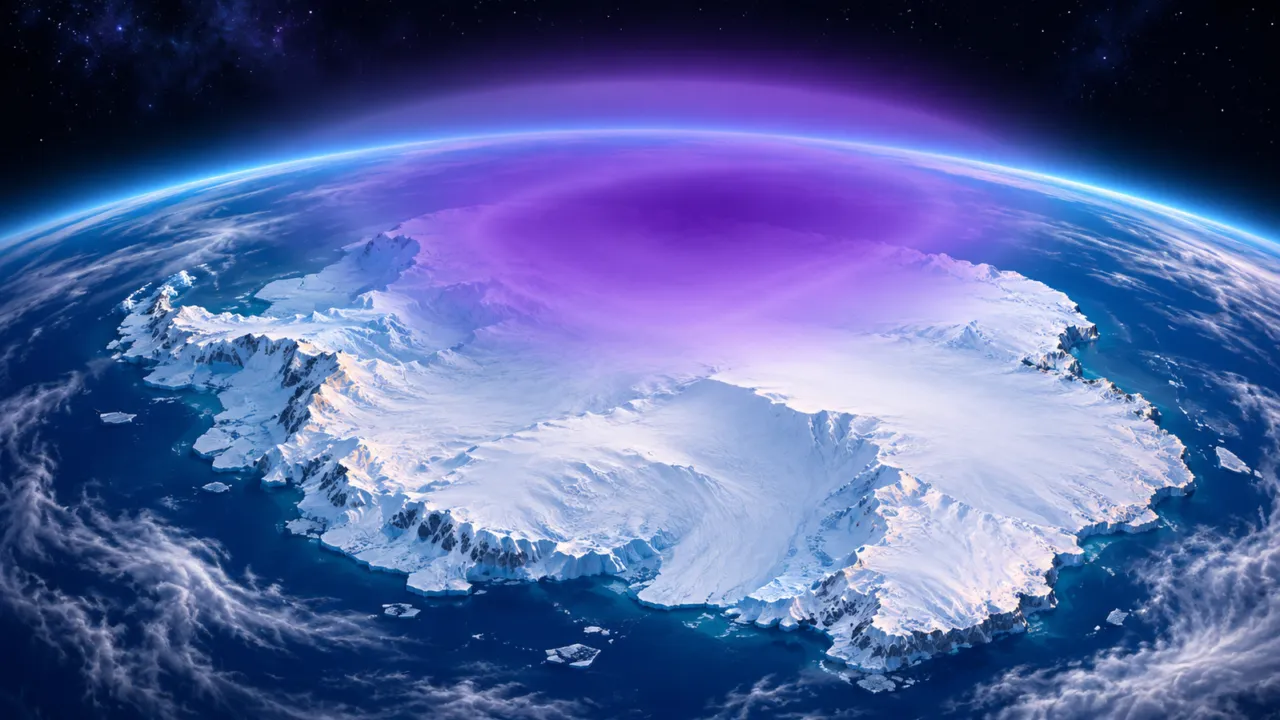
The Antarctic ozone hole reached its largest area of 2026 on September 18, NASA and the National Oceanic and Atmospheric Administration (NOAA) said. Its average size in the peak season ranked seventh in 48 years of records.
However, the agencies said long-term recovery continues. A strong polar vortex widened the hole, but ozone loss was less deep than in some earlier years.
Antarctic ozone hole: average and peak differ
NASA and NOAA report two area measures, shown below. The seventh-place ranking refers to the average from September 7 to October 13, rather than the largest single day.
| Measure | Date or period in 2026 | Area |
|---|---|---|
| Average during peak season | September 7–October 13 | 25 million km² |
| Largest single-day extent | September 18 | 27.1 million km² |
Source: NASA and NOAA
Data as of: 2026-11-04
The seventh-place ranking uses the seasonal average, not the largest single day.
NASA defines the hole as an area where ozone falls below 220 Dobson units, a measure of the amount overhead. It is a thinning of the layer, not a region with no ozone. Area describes how far that thinning spreads; depth describes how low ozone levels fall.
Why weather changes the size
According to NASA Earth Observatory, cold air and wind patterns high above Antarctica change the hole from year to year. Colder conditions favor a wider hole and greater ozone loss at its core.
NOAA scientist Amy Butler said weather systems that usually weaken the polar vortex were unusually weak in August and September. This allowed a larger area with conditions that favored ozone loss.
NASA Earth Observatory explains that chlorine and bromine from human-made chemicals destroy ozone. For example, chlorofluorocarbons once used in fridges and spray cans can stay in the air for decades. Sunlight breaks them apart high in the atmosphere, releasing chlorine that attacks ozone.
What this means for people and climate
The ozone layer blocks harmful ultraviolet light from the Sun, according to NASA Earth Observatory. The agency links loss of that protection to risks including sunburn and skin cancer.
Ozone loss is not the main cause of global climate change, the UN ozone assessment explains. Heat-trapping greenhouse gases drive most of that warming. However, the problems are linked: several chemicals that harm ozone also warm the climate.
The assessment also finds that Antarctic ozone is recovering despite large swings in the size and duration of the hole. Thus, one large season does not by itself settle the long-term trend.
NASA and NOAA said the 1987 Montreal Protocol supports recovery, but old products and landfills can release chemicals for decades. The agencies expect the hole to recover by the 2070s.
Sources: NASA and NOAA report, NASA Earth Observatory, UN ozone assessment, UN ozone questions and answers