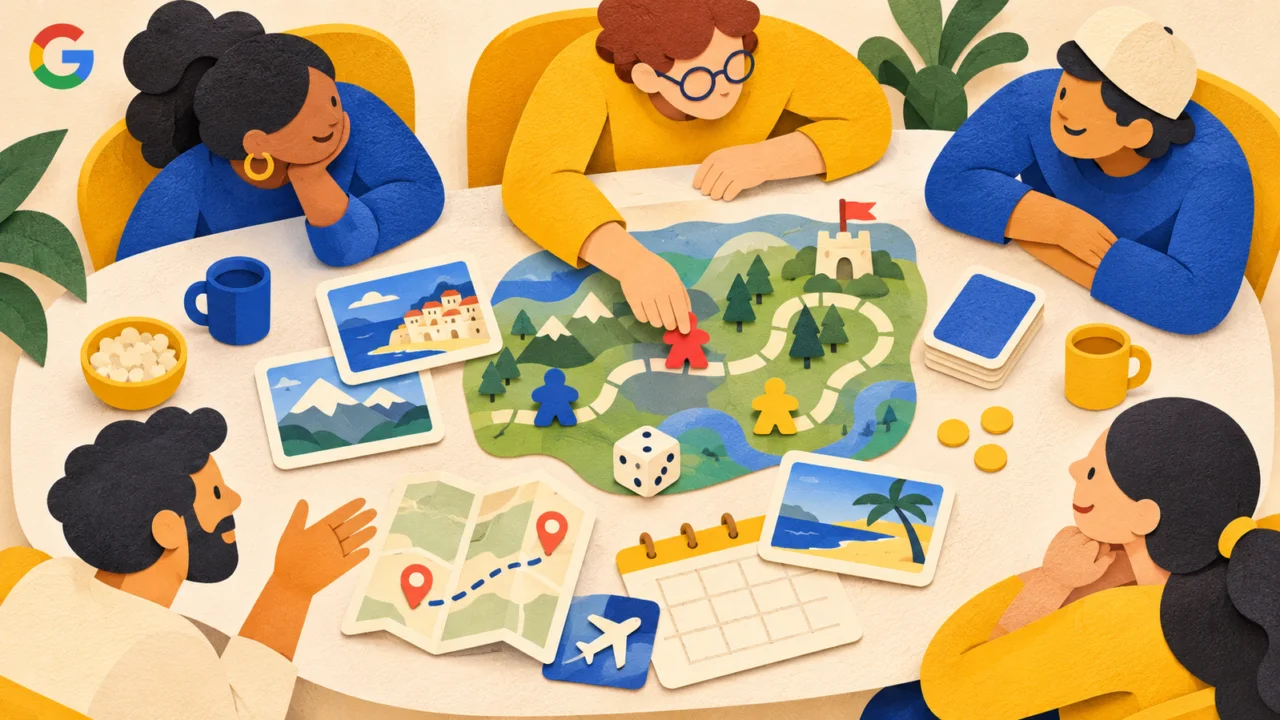
Google introduced Google Tabletop on November 11, 2026, opening a US waitlist for a shared planning tool from Google Labs. The company says the experiment is for adults aged 18 and over.
Groups can add files, links and ideas, then ask the built-in assistant to make tools such as trip plans or dinner polls. Google’s launch announcement says members can use these tools at the same time after joining through an invite link.
How Google Tabletop turns chat into shared tools
Google’s FAQ describes three parts of each space: chat, interactive tabs and shared context. A tab is a small web app inside the space, such as a checklist, poll or countdown. Shared context holds files, links and details the assistant remembers for that group.
The same guide says members can ask @tabletop to create or change a tab, answer questions or sum up a chat. They can also edit a tab’s code directly. A poll could help a group choose a dinner date; a checklist could track who brings each item.
Google lists expense splitters and tournament brackets among the launch examples. These give a group something to fill in and use together, rather than just a written answer to a question.
Who can see the group’s information
The FAQ says a space starts out visible only to its creator. Admins can change invite settings, while members can limit some tabs and chat threads to selected people. The assistant’s memory stays within each space, and any member can view, edit or clear it.
Leaving has a limit: the FAQ says messages, tabs and uploads that a member has not deleted remain for the others. Admins can also delete a space and all its contents. For a trip plan or shared project, those rules matter when deciding where to keep the only copy.
Tabletop’s welcome notice says Google collects prompts, uploads, generated content and data from tabs, and human reviewers may inspect some data. It advises against entering sensitive or confidential details. Other members may also view or share material added to a space.
The notice also says users can opt out of using future chats and data to train Google’s generative AI models. If one member opts out, training is turned off for that whole space. That setting does not remove the sharing and review rules described in the notice.
Access starts with a US waitlist
Google’s sign-in notice requires a personal Google account; work and school accounts are not supported yet. The launch announcement directs eligible US adults to the Tabletop waitlist. The FAQ points readers to Google Labs for news on wider access.
Sources: Google announcement, Google Tabletop FAQ, Google Tabletop access and welcome notices