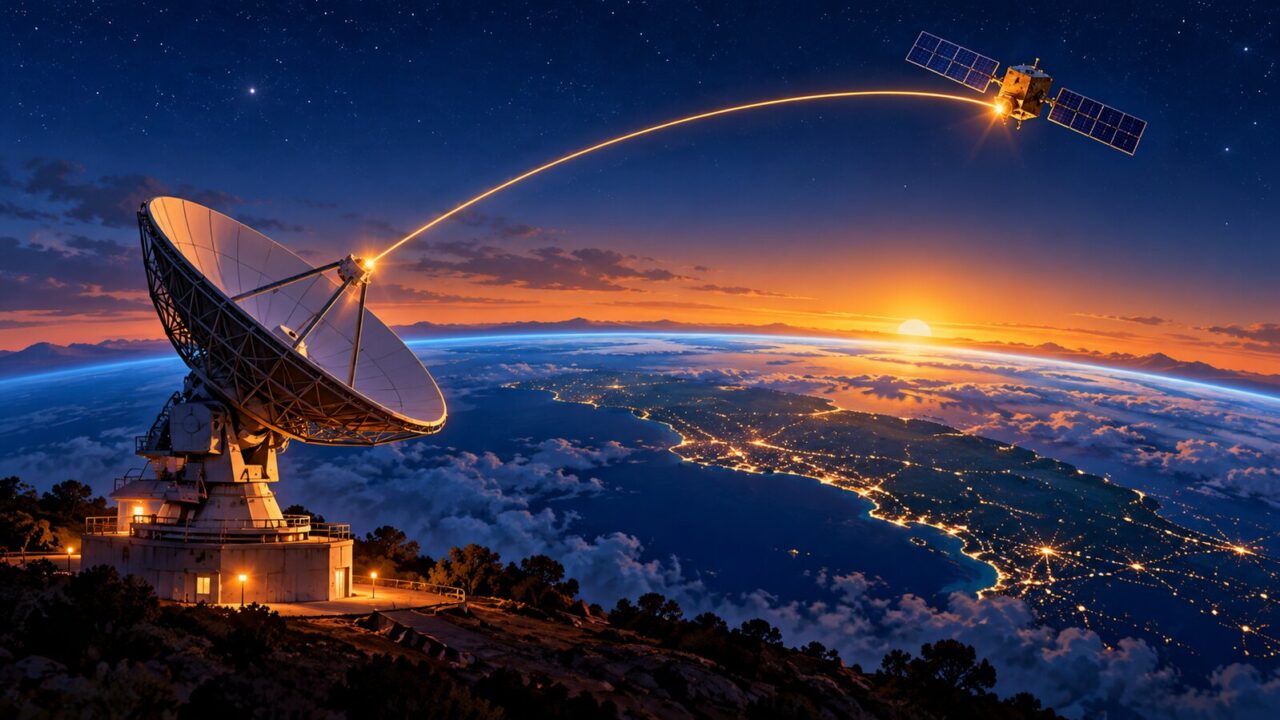
Google said on October 30, 2026, that its Project Suncatcher satellite had generated an artificial intelligence response in orbit. The company received the output during a ground-station pass near Svalbard, Norway.
The satellite is a research prototype, built with Planet and launched on October 1 aboard SpaceX’s Transporter-18 mission, Google said. The project is testing whether computing hardware used for machine learning can operate reliably in space.
Project Suncatcher runs an onboard model
According to Google’s mission update, engineers sent a prompt to the Gemma 4 model running aboard the satellite. They asked for a haiku about space and received the generated poem through the satellite’s downlink.
Google described it as the first AI response from a data-center-class Tensor Processing Unit in orbit. A Tensor Processing Unit, or TPU, is Google’s specialized machine-learning processor. The reported milestone concerns that hardware, rather than all uses of AI in space.
The company said engineers had powered the host and TPU trays and completed early machine-learning tests before receiving the reply. Follow-up prompts requested limericks and telemetry describing the technical condition of the payload systems.
Heat and radiation remain research challenges
Google’s engineering overview identifies cooling as a central obstacle. Its processors concentrate heat in a small area, while the vacuum of space provides no airflow to carry that heat away. The project therefore relies on radiators to release heat.
The same overview describes ground tests of launch vibration and radiation exposure. Engineers shook the satellite along three axes. They also ran AI workloads during proton-beam tests at the University of California, Davis, watching for chip errors.
Google says the longer-term concept would connect satellites to handle larger computing workloads. Its research overview presents that system as a future possibility, with the prototype gathering operating data to inform later designs.
Google’s October 30 update says the next tests will examine thermal stress and radiation exposure in orbit. The company is targeting a pair of interconnected satellites as its next milestone in 2027.
Sources: Google — First response from the prototype satellite, Google — Prototype satellite launch, Google — Engineering challenges behind Project Suncatcher