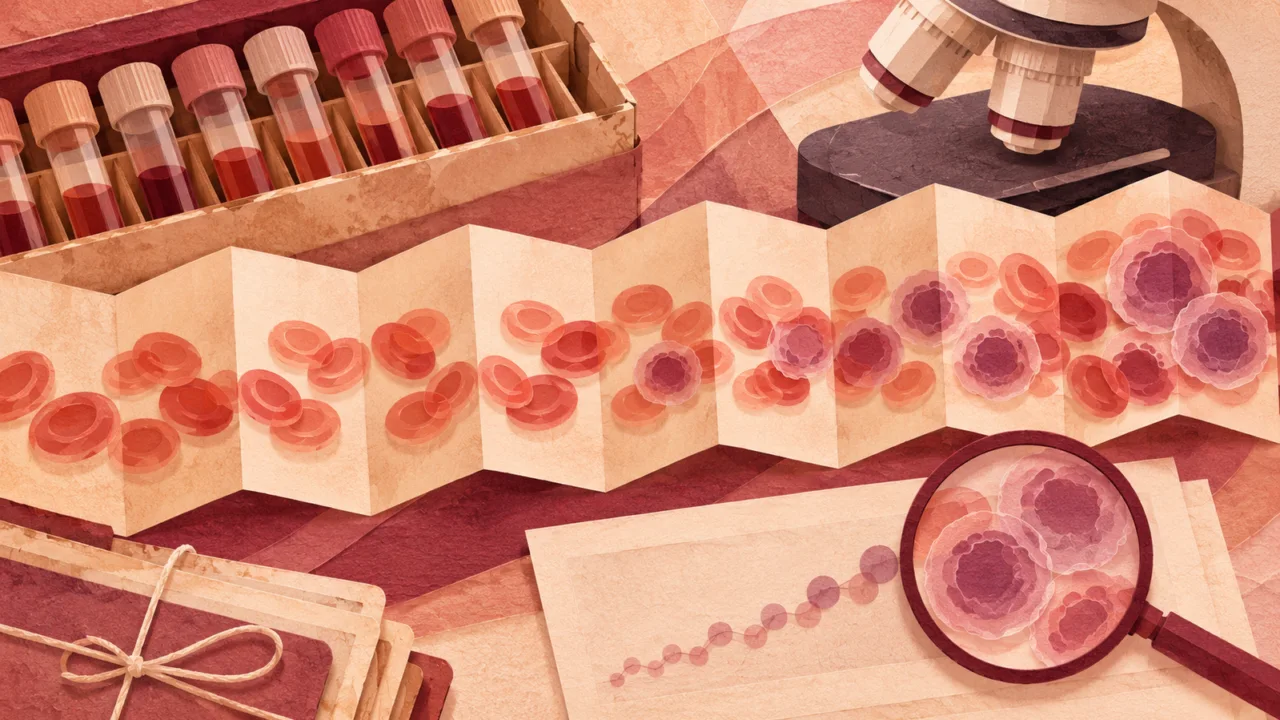
Leukemia origins can stretch back decades before diagnosis, a British study published in Nature on November 11, 2026, found. Cambridge and University College London researchers used stored blood samples to reconstruct changes that preceded acute myeloid leukemia, or AML.
The team estimated that the first cancer-driving mutation arose by age 20 in about two-thirds of the women who later developed AML. Those ages came from mathematical models of later blood samples, not tests of blood collected during childhood.
Tracing leukemia origins through stored blood
The peer-reviewed study used stored samples from a trial that screened women for ovarian cancer. Its authors compared two groups of women of similar ages. One group later developed AML; the other stayed free of blood cancer. This was an observational study, not a trial of a leukemia screening test.
According to the Nature paper, repeated samples let the team follow genetic changes over time rather than rely on one snapshot. The table shows the size and time span of the study.
| Study measure | Finding |
|---|---|
| Women who later developed AML | 47 |
| Women in the final control group | 46 |
| Blood samples from future AML cases | 249 |
| Earliest stored sample before diagnosis | Up to 15 years |
| Median age at AML diagnosis | 72 years |
Source: Watson et al., Nature
Data as of: 2026-11-11
The study compared stored samples from women who later developed AML with a matched control group.
The researchers used a sensitive DNA sequencing method called TETRIS-seq to detect small groups of cells with shared mutations. They then fitted models to the way those groups grew and competed. Each group, called a clone, descends from a cell that carries the same genetic change.
Why early mutations do not mean early cancer
Memorial Sloan Kettering Cancer Center explains that blood-forming stem cells live in bone marrow and produce blood cells. When one altered stem cell makes many cells with the same mutation, the process is called clonal hematopoiesis. The center stresses that this condition is not cancer.
Its patient guidance says most people with this condition have a low risk of blood cancer. Fewer than one in 100 develop a blood cancer each year. That broad estimate is background information, not a prediction for the women selected for the new study.
The Nature study helps explain why one genetic change may not be enough. For example, early clones often grew slowly, taking years to double. Further driver mutations gave some daughter clones a larger growth advantage, allowing them to outgrow other blood cells.
In at least a third of the AML cases, the authors found that a clone had already come to dominate the blood. They saw no such complete takeovers in the control group. A separate analysis of UK Biobank data linked these takeovers to higher odds of later myeloid leukemia.
What leukemia origins research cannot yet predict
The authors note an important limit: they had no samples taken at AML diagnosis. As a result, they could not be certain that the earlier clones they measured gave rise to each cancer. Some final genetic changes may also have happened after the last stored sample.
However, not every case offered a long warning period. In 10 of the 47 cases, the paper found no detectable clone or one that appeared only one to two years before diagnosis. The team says its test may have missed rare mutations or very small clones.
The study involved women diagnosed between ages 53 and 83, according to the paper. The study therefore does not show how well such a test would work in men or younger people.
A separate NHS blood test trial asks if tests can help doctors spot cancer sooner. The University of Birmingham says it will enroll people with belly symptoms. That trial tests care in practice; the leukemia origins study looks back at stored samples.
Testing whether prevention is possible
Memorial Sloan Kettering does not recommend routine testing for clonal hematopoiesis in its patient guidance. It says there are currently no treatments for the condition. The new study did not test whether treating a growing clone prevents leukemia.
However, the Cambridge team says slowing a high-risk clone could potentially reduce its chance of acquiring further harmful mutations. Testing whether that can be done safely and effectively in people at high risk is the next step, the university says.
Sources: Nature, University of Cambridge, Memorial Sloan Kettering, University of Birmingham