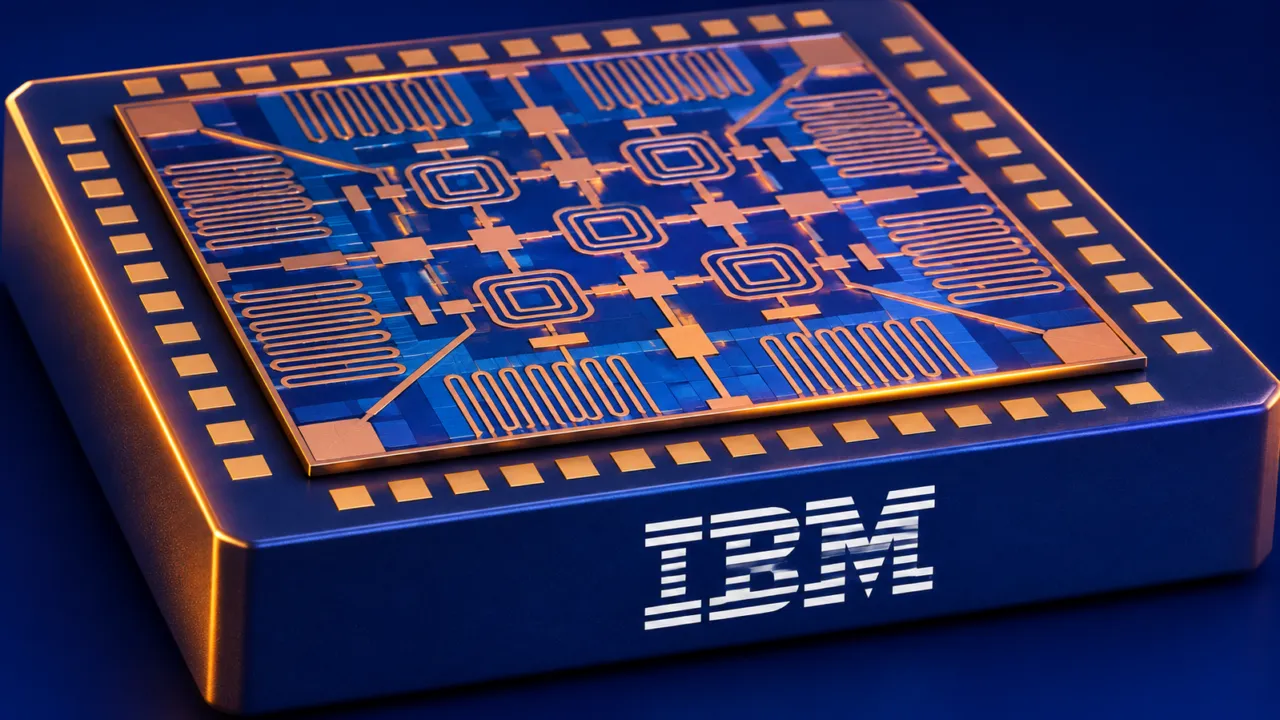
IBM announced plans for its IBM Nighthawk r3 quantum processor on November 11, 2026. The company aims to link two chips into a 1,040-qubit system in 2027.
IBM says each r3 chip will support 10,000 quantum operations on 520 programmable qubits. The plan builds on its current r2 processor, whose faster repeated runs help researchers gather results sooner.
What IBM Nighthawk r3 would add
IBM describes a larger chip that can connect to others through special links called l-couplers. The table separates hardware already available from the company’s plans. These figures count programmable qubits, the units users control for calculations.
| System | Programmable qubits | Status |
|---|---|---|
| Nighthawk r2 | 120 | Available; reported performance |
| Nighthawk r3 | 520 | Planned processor |
| Two linked r3 processors | 1,040 | Planned system for 2027 |
Source: IBM
Data as of: 2026-11-11
IBM plans to move from 120 programmable qubits on r2 to 520 on r3, then link two r3 processors.
IBM also reports customer and partner speedups of up to 19 times on r2 compared with earlier IBM quantum processors. That comparison is with other quantum hardware. It does not show that the chip beats standard computers at all tasks.
Why resetting a qubit matters
IBM’s technical guide explains another source of speed: less waiting between runs. A quantum circuit starts with qubits in a known state and ends with a measurement. The machine then resets the qubits before running again.
According to IBM, r2 actively draws each qubit back to its starting state through a link to a cold environment. This reduces idle time between runs to as little as one microsecond, or one millionth of a second. As a result, faster resets let teams run more tests in the same time.
The same IBM explanation shows why raw hardware counts can mislead. For example, r2 has 120 programmable qubits, plus 218 couplers and 120 reset elements: 458 physical quantum elements in total. So these extra parts help the chip work, but users cannot use them all as qubits for calculations.
What a quantum computer can actually do
The US National Institute of Standards and Technology (NIST) explains that qubits can hold a mix of quantum states. However, reading them yields only limited information. So a quantum computer cannot just test all answers and hand over the right one.
NIST says researchers hope to use larger, more reliable machines to model molecules and materials. Those uses could aid drug research or the design of chemical catalysts. However, these are possible uses, not results shown by the new chip.
NIST also says quantum computers could work alongside conventional machines. IBM’s current development work follows that approach: its conference update describes joint research with Oak Ridge and AMD. Earlier Likiweeks coverage explains how their error-correction testbed combines quantum and conventional computing.
The links IBM Nighthawk r3 will need
An IBM laboratory study reported in an arXiv preprint tested four links between two older 120-qubit Nighthawk r1 processors. The researchers report that magnetic fields during cooling can impair the cables. They added magnetic shielding to reduce that loss.
The study shows why linking chips is hard: their fragile quantum states need protection, too. Its results concern r1 hardware, not a completed IBM Nighthawk r3 system. IBM’s next stated step is to connect two r3 processors in 2027.
Sources: IBM announcement, IBM reset explanation, NIST, IBM interconnect preprint, IBM development update