
Data center air pollution can reach people far from the servers that drive it, MIT-led researchers found. Their peer-reviewed modeling study, published November 19, 2026, in Environmental Research Letters, estimates that generating power for data centers contributed to about 650 premature deaths across the contiguous US in 2023.
The link runs through two systems. First, a data center can draw power from a plant in another state. Then winds can carry pollution from that plant farther still.
Where data center air pollution lands
An earlier public preprint of the study provides the detailed state-level breakdowns. In it, Virginia’s data centers used 33.9 terawatt-hours of electricity in 2023, the most of any state. The model shows power plants across PJM Interconnection, a multistate regional grid, responding to that load. By contrast, much of Texas’s grid response came from plants within Texas.
As a result, some Midwestern states had high estimated death rates per resident even where local data centers drew little power. Moving from per-capita rates to total counts, the table below compares electricity use and total estimated deaths in four states. Specifically, each state total reflects grid power used by data centers across the entire study area.
| State | Electricity used by data centers | Total estimated deaths among residents |
|---|---|---|
| Virginia | 33.9 TWh | 25 |
| Texas | 21.8 TWh | 69 |
| Ohio | 2.4 TWh | 36 |
| Missouri | 1 TWh | 23 |
Source: Chen et al. preprint, Table S1
Terawatt-hours (TWh) measure electricity use. Total death estimates reflect pollution from power generated for data centers across the contiguous US.
For example, Virginia’s data centers used about 34 times as much electricity as Missouri’s, based on the figures in the table. Yet the model puts the total death tolls in the two states within two deaths of each other.
How power plants change the air
To trace data center air pollution, the team ran the 2023 grid twice, first with its full electricity load and then without data center demand. The preprint describes a grid model with 64 regions. As a result, the researchers could see which plants generated more power when data centers were included. In the model, gas and coal supplied most of that extra power.
Next, the team modeled what happened when those plants released more nitrogen oxides and sulfur dioxide. Once in the air, those gases can help form fine particles. In parts of the Midwest, for example, ammonia from farms helped form those particles. Nitrogen oxides can also help form ozone near the ground when they react with other gases in sunlight.
The model put the rise in annual fine particle levels at 0.02 to 0.08 micrograms per cubic meter across much of the central and eastern US. In some places, however, the increase approached 0.2. Meanwhile, ozone tended to rise downwind in summer. Yet it could fall in some emitting regions in winter.
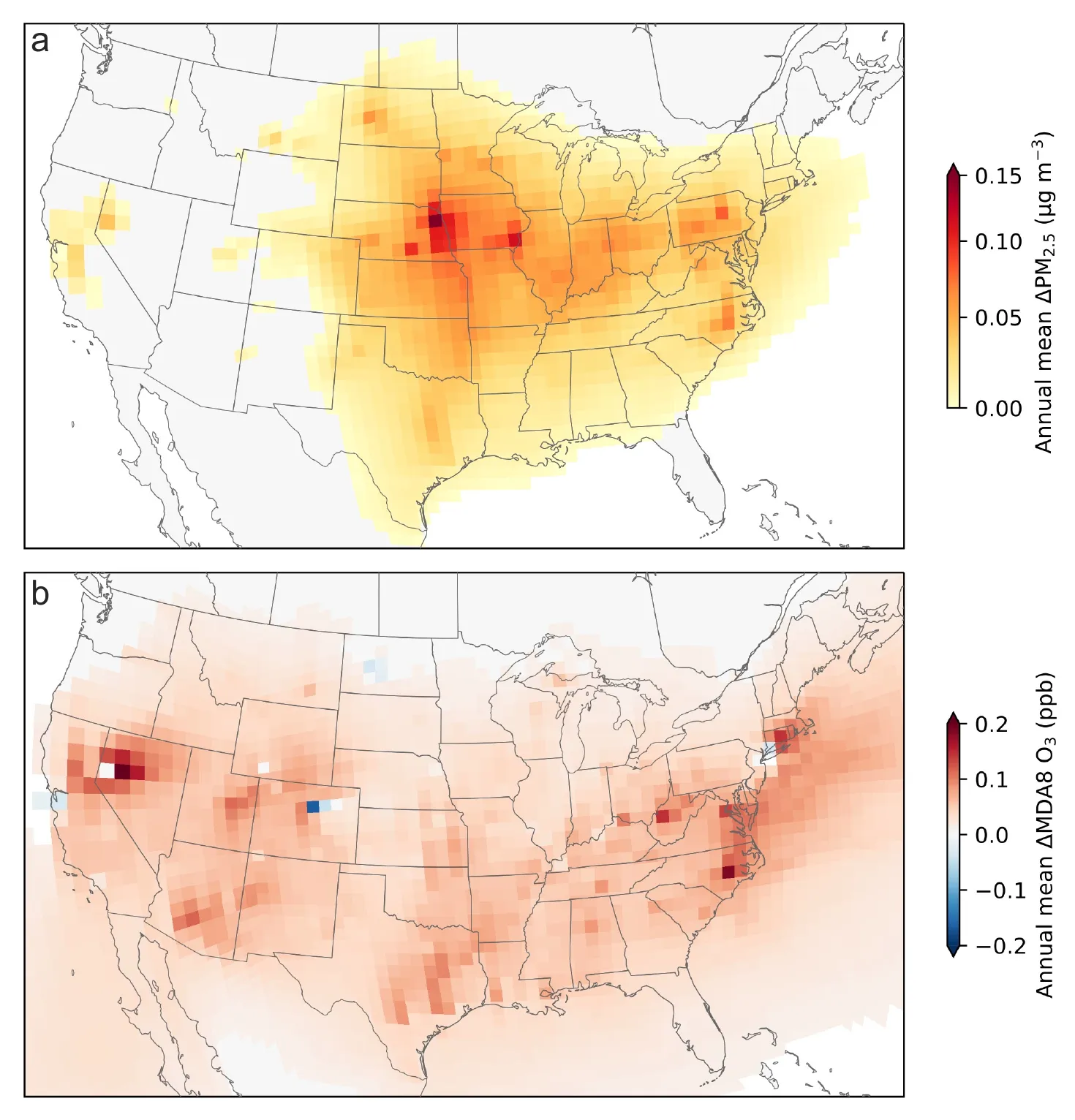
What data center air pollution estimates cover
Then the team used past health studies to estimate deaths from the changes in air quality. Fine particles accounted for 513 of the estimated 650 premature deaths, while ground-level ozone accounted for 137. In the preprint, data centers required 171 terawatt-hours, or about 3.8% of modeled grid generation. Yet they made up about 5.3% of the 12,247 deaths the model linked to air pollution from all power generation.
The preprint also gives a 95% confidence interval of 559 to 740 deaths. That range reflects uncertainty in how people respond to pollution. However, other parts of the model also carry uncertainty, such as which power plants would run.
Moreover, the model covers all grid electricity for data centers, not just artificial intelligence (AI). In addition, the air model divided the country into cells roughly 31 miles across. Because of that scale, it cannot estimate exposure at a home or school. Finally, the study excluded backup diesel units and other on-site generators.
What rising power demand could change
In a separate report, Lawrence Berkeley National Laboratory estimated that US data centers used 192 terawatt-hours in 2024, or 4.7% of the nation’s electricity use. By 2030, its main case reaches 649 terawatt-hours, or 11.8% of projected US electricity use.
For example, one scenario assumes that running AI models takes more energy. As a result, it adds 133 terawatt-hours to the main case. Overall, the lab’s five scenarios and combined uncertainty range span 521 to 843 terawatt-hours in 2030.
| Case | Data center electricity use | Share of projected US electricity use |
|---|---|---|
| Reference case | 649 TWh | 11.8% |
| Consolidated deployment | 578 TWh | 10.5% |
| More use of custom AI chips | 664 TWh | 12.1% |
| Shorter AI chip life | 590 TWh | 10.7% |
| Higher energy use to run AI models | 782 TWh | 14.2% |
| Combined uncertainty low | 521 TWh | 9.5% |
| Combined uncertainty high | 843 TWh | 15.3% |
Source: Berkeley Lab, Table 2
Five scenarios and a combined uncertainty range show how different assumptions about computing hardware and its use change future electricity demand.
However, how that demand would affect data center air pollution depends on which plants serve it and where the pollution then goes. That is because the MIT team modeled only the power plants and grid conditions of 2023.
In future work, MIT News says the team wants to look at power generated on site. It could also study how the air changes if data centers shift when they draw power.
Sources: MIT journal abstract, Chen et al. preprint and supplement, Berkeley Lab report, EPA technical guidance, EIA, MIT News