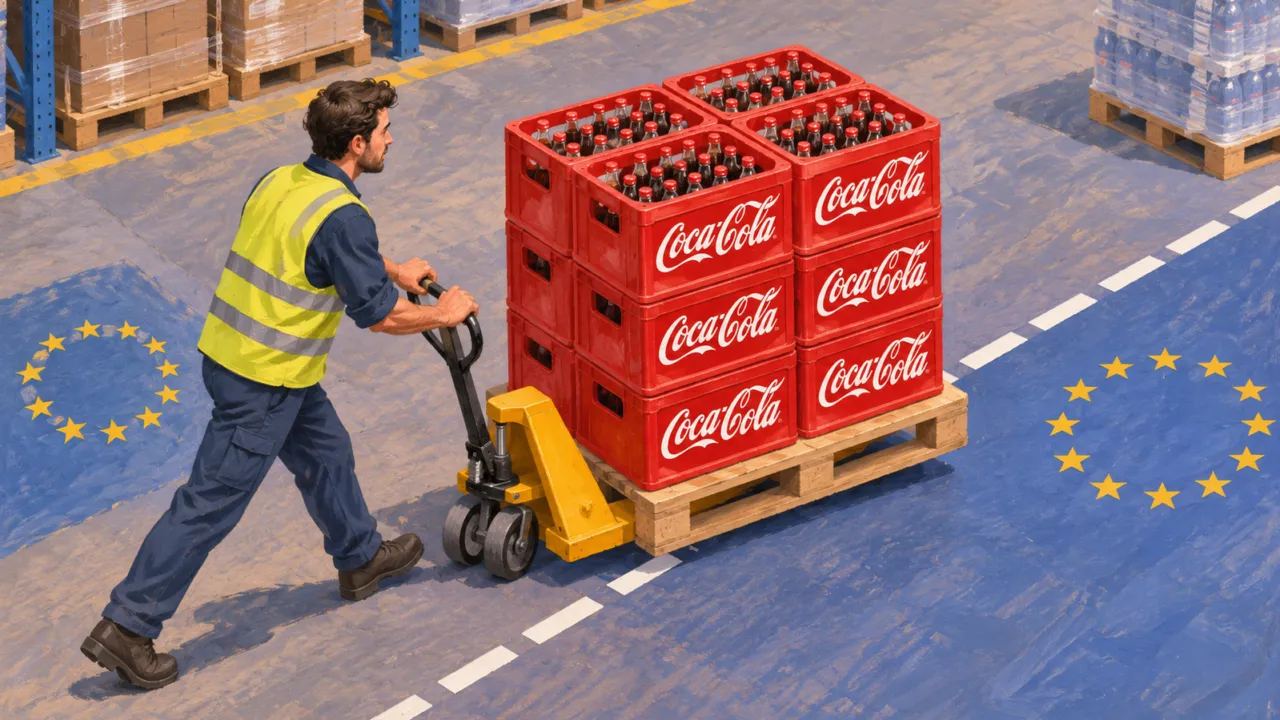
The European Commission opened an antitrust probe into Coca-Cola Europacific Partners on November 23, 2026. Regulators are checking whether the Coca-Cola bottler curbed trade in soda and sports drinks across the European Union (EU).
The case covers wholesale drinks sold to stores and supermarkets for shoppers to take home, not restaurants, hotels or cafés. Teresa Ribera, the Commission’s executive vice-president who leads EU competition policy, said trade barriers make it harder for stores to win better deals. “People across Europe enjoy soft drinks every day,” she said. “But they should not have to pay more simply because they live in one EU country rather than another.” Such curbs can also leave shoppers with less choice, she said.
Four practices under EU review
According to the Commission, the probe covers wholesale supplies of carbonated soft drinks and sports drinks to retail buyers. Its inquiry centers on four suspected practices:
- Giving wholesale price cuts on soda and sports drinks only if buyers did not export them to other EU states.
- Altering products across borders, such as using different packaging volumes for sodas, to slow cross-border trade.
- Offering retail buyers incentives to curb soda imports into Spain, one distinct prong of the case.
- Refusing retailers and wholesale buyers multi-country supply talks, insisting on separate national negotiations instead.
Based in the United Kingdom, Coca-Cola Europacific Partners is one of Europe’s two largest bottlers of The Coca-Cola Company’s brands. The Commission says the Coca-Cola bottler is the top soda supplier in eight EU states. Those markets are Belgium, France, Germany, Luxembourg, the Netherlands, Portugal, Spain and Sweden.
Coca-Cola bottler pledges to cooperate
Coca-Cola Europacific Partners acknowledged the probe and said it takes competition law very seriously. The firm also said it stays committed to following the law and will keep engaging fully with the Commission. It declined to say more at this stage.
The case follows surprise checks the Commission ran at the firm’s sites in several EU states in March 2025. It turns on Article 102 of the Treaty on the Functioning of the European Union. That rule bars firms from abusing a dominant market position when their conduct can affect trade between EU states.
Firms found in breach of EU antitrust rules face fines of up to 10% of their total annual turnover from the prior business year. Opening a probe does not mean the Coca-Cola bottler broke the law. The Commission said it will give case AT.40860 priority, though there is no legal deadline for a ruling.
Wider push against EU trade barriers
The case sits alongside a wider Brussels push against territorial supply constraints. Those practices by big suppliers stop stores or wholesalers from buying goods in one EU state to sell in another. Because competition rules do not cover every such curb, the Commission is running a public consultation through December 4, 2026, on new tools.
Earlier EU cases show the stakes for food and drink suppliers. On May 23, 2024, the Commission fined Mondelēz €337.5 million for curbing cross-border trade in chocolate, biscuits and coffee.
Sources: European Commission press release, Coca-Cola Europacific Partners, European Commission commissioner profile, European Commission fines guide, European Commission consultation, European Commission Mondelēz ruling