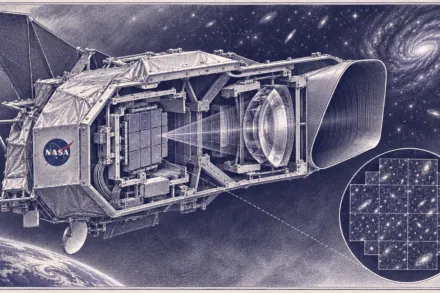
NASA announced on November 19, 2026, that researchers had identified a gamma-ray pulsar in 15 years of public data from its Fermi space telescope. The team traced the signal to a neutron star that spins about 261 times a second.
A peer-reviewed study in Physical Review Letters describes how the team found the star, named PSR J1622−7204. Fermi had recorded a faint gamma-ray source in that part of the sky for years. The researchers used a technique also used in cryptography to show that some of those rays had arrived in a repeating rhythm.
How a gamma-ray pulsar comes into view
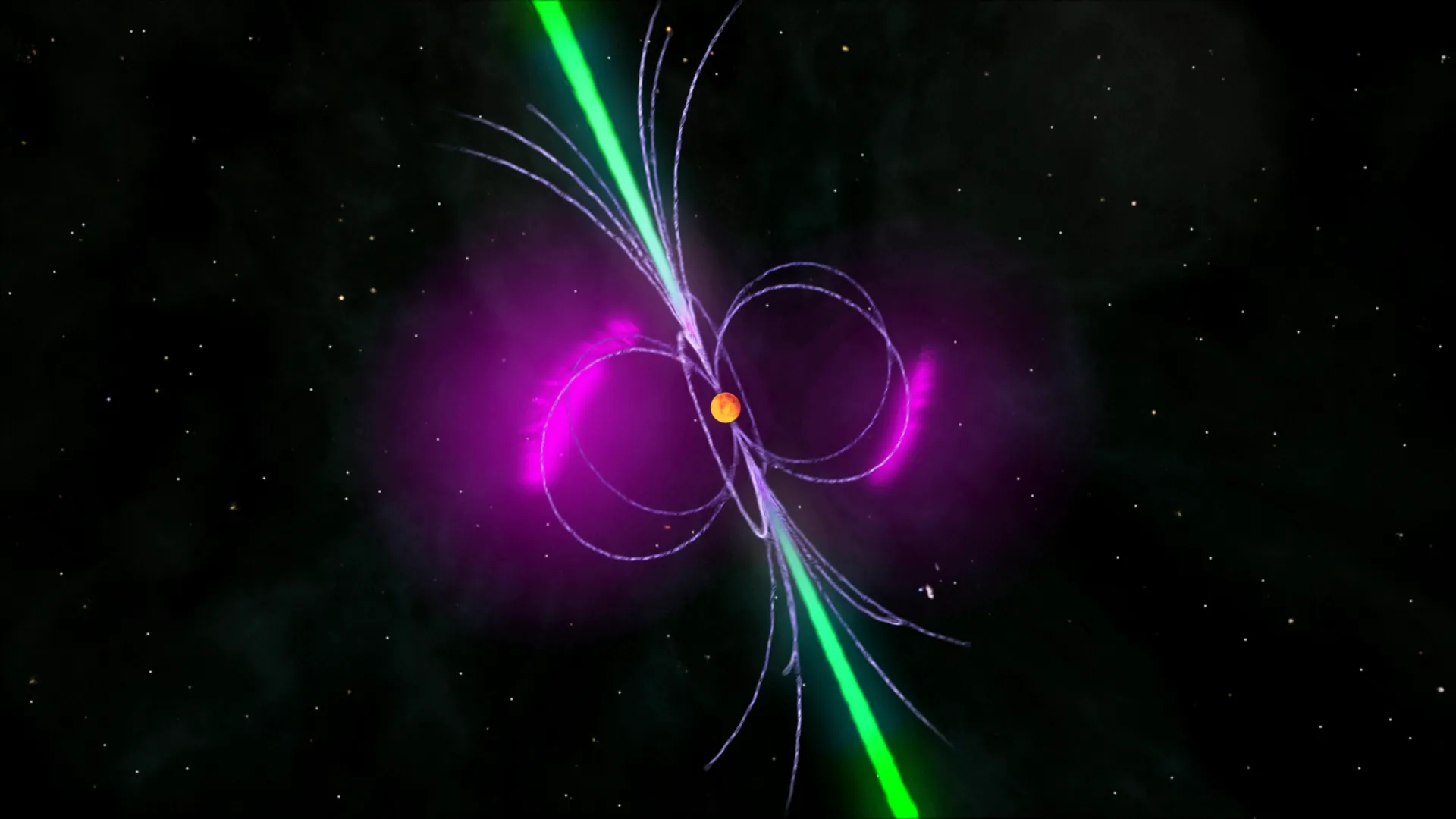
When a high-mass star collapses, it can leave behind a dense core called a neutron star. Some of these cores spin rapidly and have strong magnetic fields. As a beam from one of these stars sweeps past Earth, a telescope can pick up a pulse. The pulse tends to arrive at the same point in each turn.
Gamma rays are the most energetic form of light. Pulsars can also emit radio waves, and their radio and gamma-ray beams can sweep across different parts of the sky. So a radio telescope can miss a pulsar that Fermi can see. In this case, two earlier surveys with South Africa’s MeerKAT radio telescope found no radio pulse. The star’s radio beam could miss Earth, or the signal could be too faint for those observations.
The clock hidden in Fermi’s photon data
Fermi’s Large Area Telescope records individual gamma rays, or photons. It can time each detection to within microseconds, or millionths of a second. Even so, the study says a typical pulsar might give Fermi one photon per 100 million turns. Photons from other sources and from diffuse emission can also reach the detector from the same patch of sky.

The team started from the catalog position of a source called 4FGL J1622.2−7202. Its gamma-ray properties suggested a pulsar. The researchers selected public Fermi data from August 16, 2008, up to a cutoff on December 6, 2023. They used photons above 100 megaelectronvolts, a measure of energy. Then they used each photon’s energy and direction to estimate how likely it was to have come from the source.
The team also had to account for the motion of the observatory and Earth. They corrected the times to a common point at the solar system’s center of mass. Earth’s orbit can make photons reach the detector up to about 500 seconds earlier or later than that reference. Since the pulsar spins in a few thousandths of a second, even a small error in its position can spoil the timing.
How the team counted the missing turns
Daniel Pook-Kolb and his colleagues came from Germany’s Max Planck Institute for Gravitational Physics, Leibniz Universität Hannover, Israel’s Weizmann Institute of Science and Sweden’s Chalmers University of Technology. They treated the missing turns as a set of whole numbers. For each trial, they randomly drew 80 of the 120 photons most likely to come from the source. Then they asked which counts could place those arrivals near the same point in a turn. Different draws gave them more chances to pick a set with fewer stray photons.
Each set of turn counts became a point in a lattice, a grid with one dimension for each of the 80 counts. The team used software to find short paths from the grid’s origin to nearby points. These paths gave them plausible combinations to test.
For each set of counts, the researchers fit a model of the star’s spin and location. It gave them the spin rate and how fast the star slows. It also told them where it was in its spin at a reference time. The model let them refine the star’s position in two directions on the sky.
The right answer ranked behind thousands of others by length. In the successful trial, the software found 318,199 short paths. Of those, 6,827 were shorter than the one that fit the star. The team then checked for pulsations using the 1,000 photons most likely to come from the source.
For each proposed clock, the researchers used a test called the H statistic to measure how strongly those events clustered at the same parts of the spin. In that trial, only one timing model cleared their threshold of 150. It scored 231. This gave the team a clock it could test against a much larger set of photons.
What confirmed the gamma-ray pulsar
The team refined its timing model with 15,905 photons. It had assigned each of them more than a 1% chance of coming from the source. Those probabilities added up to about 828 photons expected from the pulsar. In the paper’s timing plot, the pulse peaks line up at the same parts of the spin across the full span of the observations.
The star spins at about 260.896 turns per second. To get the time for one turn, divide the 1,000 milliseconds in a second by 260.896. The result is about 3.833 milliseconds. That repeating signal confirmed the identity of the Fermi source.
How much computing time each search used
According to the study, an earlier search had spent about 600 CPU-years on this target without picking up a pulse. The older method tracks timing closely within shorter spans and combines the evidence across them. The new paper puts the lattice search at about 10 CPU-hours. A CPU-hour counts one hour of work by one processor core, so many cores can finish the work in less time.
Put both budgets in hours and the earlier search used about 526,000 times as much computing time. The comparison is for one source, and only one search found its pulse. The paper also reports that one of the first 20 draws worked. Based on 1,000 trials on this same source, the researchers put the chance of success at about 1% per draw. At that rate, they estimated about 70 tries gave them even odds of seeing a pulse.
Blind gamma-ray pulsar searches and radio timing
A blind timing search starts without a known spin rate. In this case, the team had an approximate position from Fermi. It still had to find the spin rate, how fast the star was slowing, and a more precise position. A radio telescope can sometimes supply the missing clock so that a team can check Fermi’s data at that exact rhythm.
China’s Five-hundred-meter Aperture Spherical Telescope used that approach on a different Fermi source. It detected the radio pulse of PSR J0318+0253 in 2018. Astronomers then used the radio timing to find a matching pulse in 9.6 years of Fermi data. A 2025 study used the first version of the lattice method to recover that already known pulsar. The 2026 team used the extended method to identify a new one directly from its gamma rays.
What remains to be tested
The study gives a measured spin for one isolated star. If a pulsar has a companion, its orbit adds shifts to the photon arrival times. The team estimates that a blind search for a binary could cost about a million times as much as this search for one isolated star. The Weizmann Institute of Science says the team is finding other pulsars. The published study names and gives a timing solution for PSR J1622−7204.
Sources: Physical Review Letters paper, Physical Review Letters record, NASA announcement, Fermi data archive, NASA beam visualization, NASA beam image, NASA 12-year sky map, MeerKAT L-band survey, MeerKAT UHF survey, FAST discovery paper, The Astrophysical Journal proof of concept, Weizmann Institute of Science