NASA will unveil the first Roman telescope images on December 7, 2026, at the American Geophysical Union meeting in San Francisco. The public broadcast begins at 3:30 p.m. Eastern time, or 12:30 p.m. Pacific, on NASA’s live channel.
When the show starts, NASA will also post the pictures online. They will give the public its first look at how the Nancy Grace Roman Space Telescope captures large patches of sky in fine detail.

How Roman telescope images cover so much sky
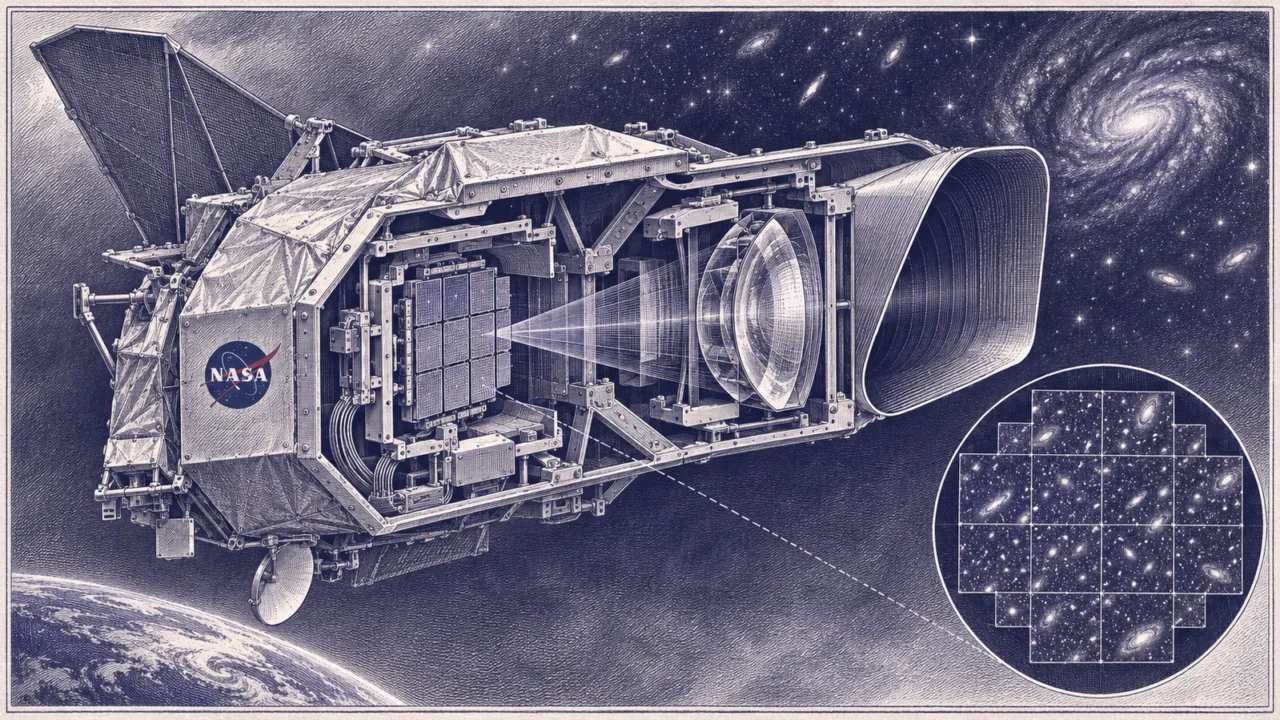
NASA built Roman’s main camera, the Wide Field Instrument, around 18 detectors. The chips sit side by side in a shallow arc. Each detector turns the light that reaches it into electrical signals. Together they produce a picture with about 300 million pixels.
That design gives astronomers two things at once. In near-infrared light, just beyond the red end of the spectrum people can see, Roman can pick out details about as fine as Hubble can. But Roman takes in much more sky in a single exposure. Astronomers can use those broad views to survey large numbers of stars and galaxies.
Roman launched from Florida on August 30. During the trip to its observing orbit, the mission team has been switching on and calibrating its systems. Its science goals include studying dark energy and finding planets around other stars.
How to find a pixel in the first pictures
NASA is also inviting the public to adopt a pixel in one of the first Roman telescope images. After the unveiling, participants can find their assigned spot and get a digital trading card with information about it.
Before the public event, reporters who sign up will get a preview at noon Eastern on December 7. The American Geophysical Union plans to make a recording of that briefing available once the public broadcast begins.
Sources: NASA event advisory, NASA camera guide, NASA telescope comparison, NASA pixel program.