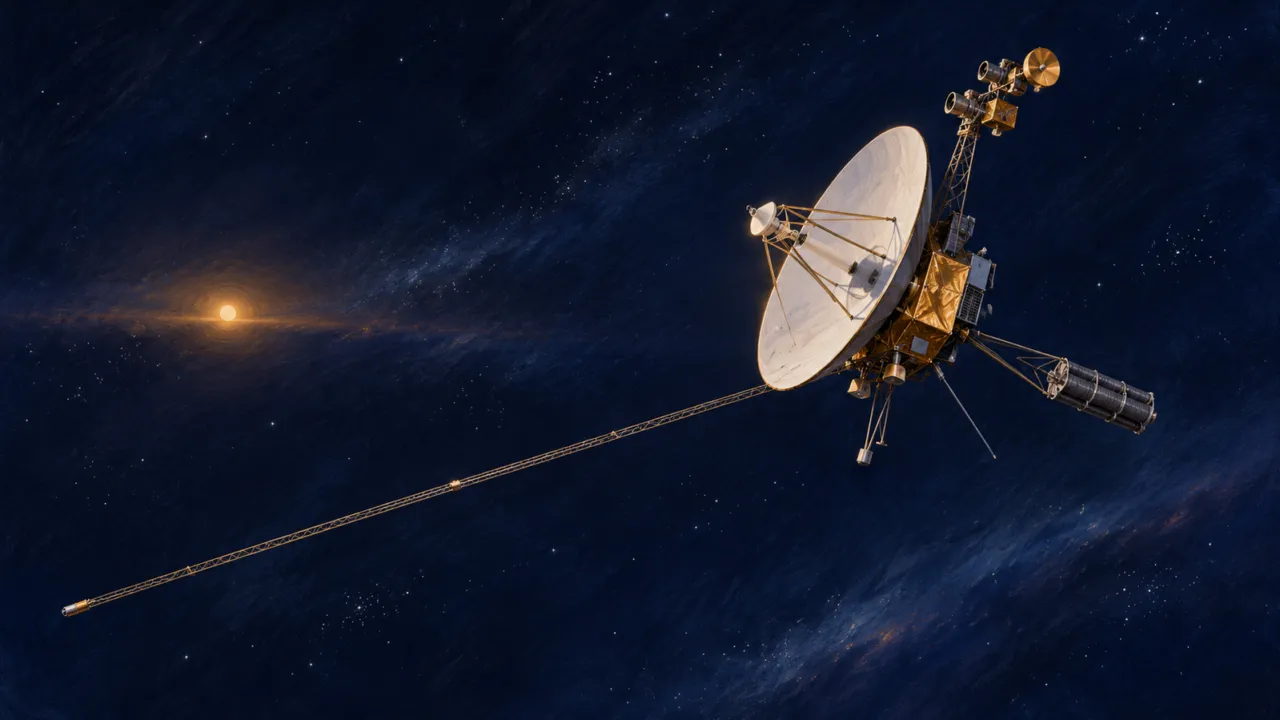
NASA says Voyager 1 will reach one light-day from Earth on November 18, 2026, at 5:16:07 a.m. EST. The spacecraft will then be about 16.094 billion miles (25.902 billion kilometers) away, farther than any other human-made object.
That distance makes even a brief exchange a two-day task. NASA’s Jet Propulsion Laboratory (JPL) explains that a radio command will need 24 hours to reach the probe. Its reply will need another 24 hours to return.
Voyager 1 approaches a distance marker
A light-day measures distance, not the age of the mission. NASA’s guide explains that radio waves travel at the speed of light, just as visible light does. The unit therefore describes both how far away the probe is and how long its signals take to arrive.
For comparison, sunlight takes about eight minutes and 20 seconds to reach Earth, according to the guide. By that milestone, the probe will have spent more than 49 years traveling from Earth. It launched in 1977.
JPL says nothing aboard the spacecraft will change when it reaches the marker. Nor will it detect a change in its surroundings. This is a measure of its distance from Earth, rather than a new boundary in space.
The science continues without cameras
Caltech’s account traces a different crossing to 2012, when Voyager 1 entered interstellar space. It passed beyond the heliopause, the outer boundary of the Sun’s bubble of particles and magnetic fields. Voyager 2 followed in 2018.
The probes now provide the only direct measurements from interstellar space, Caltech says. Those measurements help scientists model the Sun’s protective bubble.
NASA’s instrument list shows that the probe’s cameras have been off since February 14, 1990, to save power. Its magnetometer and plasma wave instrument remain on. The continuing mission studies its surroundings through measurements, rather than new photographs.
Power and repairs set the limits
JPL says both probes generate electricity from the heat of decaying plutonium and lose about four watts of power each year. In September 2026, engineers switched off three devices and replaced them on Voyager 1 with lower-power alternatives. The changes also had to keep the spacecraft warm enough to work.
The team then lost contact during two scheduled communications attempts on October 18 and 19. The signal returned on October 20 before engineers sent troubleshooting commands, according to JPL. A switch to backup thrusters had occurred, but the cause of the communication loss remained under investigation.
NASA’s light-day guide puts Voyager 2’s own crossing on a later timetable: November 2035. Its route took it past Uranus and Neptune after the two spacecraft launched in 1977.
Sources: NASA mission status, NASA light-day guide, JPL, Caltech