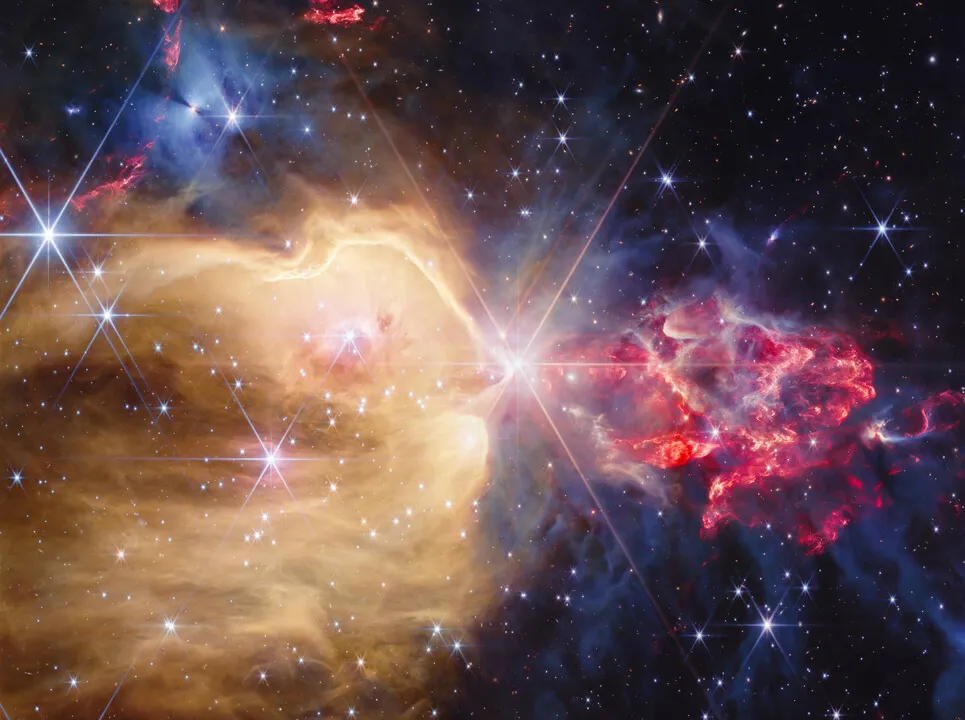
NASA featured the James Webb Space Telescope’s view of NGC 7129 as its Astronomy Picture of the Day on November 16, 2026. The infrared image shows young stars shaping a cloud of gas and dust in the constellation Cepheus.
The scene places stars at different stages of growth beside one another, according to the mission’s image guide. The gold-colored region contains more mature young stars; the red clouds shelter objects still gathering mass. Their outflows change the gas around them.
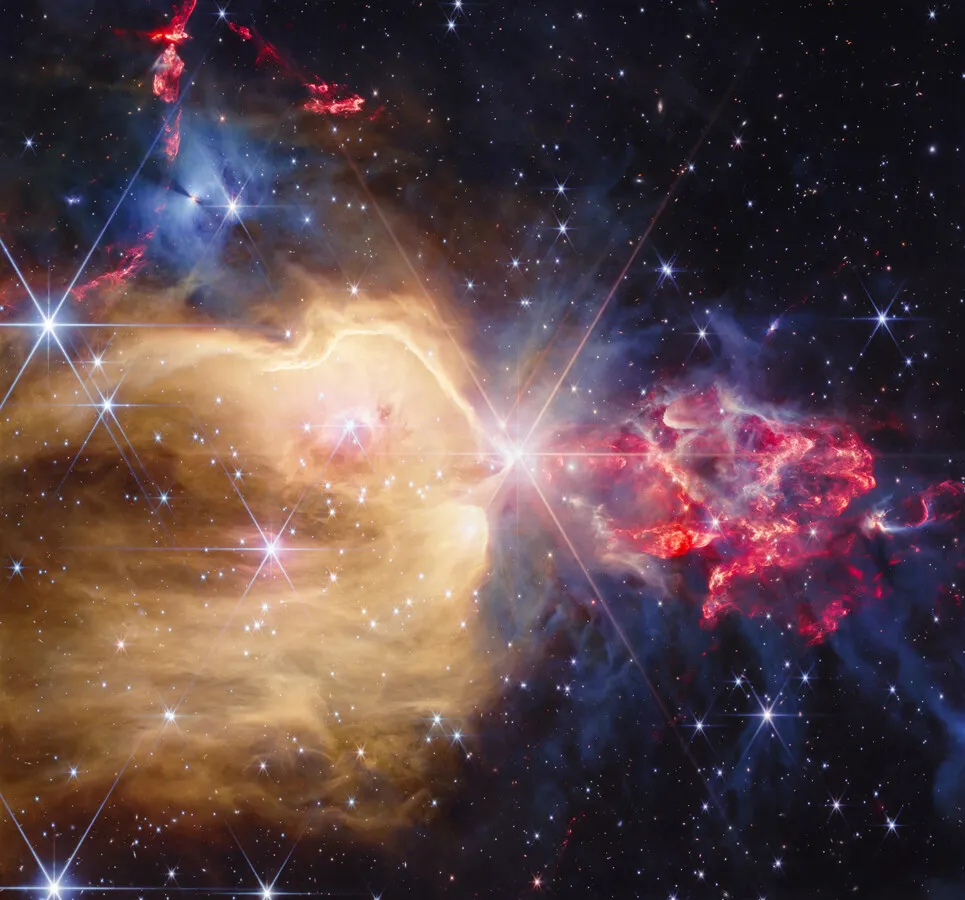
Reading the NGC 7129 image from left to right
ESA’s release identifies the bright central star as LkH-alpha 234. It has mostly finished collecting material and is shrinking under gravity, which raises its temperature. It has not yet reached the stage of steadily fusing hydrogen like the Sun.
To its left, earlier outflows helped carve a cavity in the cloud, the release says. Starlight and outflows make the gas glow. They also push some gas away and squeeze other parts, creating conditions in which more stars could form.
On the right, younger objects called protostars remain wrapped in dense material. As ESA explains, they gain mass while also throwing some material outward. These flows strike nearby gas, heating it through shocks and producing the clumpy structures shown in red. Several flows overlap along the line of sight.
NASA’s image guide distinguishes hot hydrogen atoms in the left-hand region from cooler hydrogen molecules on the right. A molecule holds atoms together; heat from the more mature stars breaks those bonds. The gray areas mark the coldest, densest gas, where stars have yet to form.
The colors translate invisible light
Webb did not record this scene as a color snapshot like a phone photo. ESA’s image-processing guide explains that each filtered exposure measures light in shades of gray. Image specialists assign colors to those separate frames, then combine them so different wavelengths become visible to human eyes.
For NGC 7129, the Near-Infrared Camera used six filters, according to NASA’s image record. The finished picture maps their signals to blue, cyan, yellow and red. Those colors represent measured infrared light; they are not the colors a visitor would see with unaided eyes.
The ESA guide describes this as representative color. The positions and shapes come from observations, while the palette helps separate features detected at different wavelengths. Thus a red patch identifies selected infrared signals, rather than serving as a simple visible-light temperature gauge.
The star-shaped rays are not jets
The sharp rays around bright stars have a different cause from the cloudy outflows. NASA’s diffraction guide explains that light bends and interacts around the telescope’s edges. Its primary mirror and the supports holding its secondary mirror create the familiar eight-pointed pattern. Those spikes are an optical effect, not eight streams of matter leaving each star.
When Webb observed NGC 7129
The NASA record places NGC 7129 about 3,300 light-years away and gives this view a width of about 5.7 light-years. Webb collected the data on December 17, 2025; the image was released on October 6, 2026. Its November APOD appearance does not mark a new observation.
ESA says astronomers will continue studying these Webb data to trace how the stars and protostars affect nearby gas and dust.
Sources: NASA image data, ESA/Webb release, ESA/Webb image processing, NASA diffraction guide, NASA APOD